Note
This tutorial is available as a Jupyter notebook. Download notebook
Tutorial 07: Hyperparameter Tuning#
🟡 Intermediate — Familiarity with ML concepts helpful
Learn systematic approaches to finding optimal hyperparameters for your boosted models.
What you’ll learn#
Important hyperparameters and their effects
Grid search and random search
Best practices for tuning
Avoid common pitfalls
[1]:
import numpy as np
import matplotlib.pyplot as plt
from sklearn.datasets import make_regression
from sklearn.model_selection import train_test_split, cross_val_score, GridSearchCV, RandomizedSearchCV
from scipy.stats import uniform, randint

from boosters.sklearn import GBDTRegressor
Key Hyperparameters#
Parameter |
Default |
Effect |
Tuning Range |
|---|---|---|---|
|
100 |
Number of trees |
50 - 1000+ |
|
0.3 |
Step size |
0.01 - 0.3 |
|
6 |
Tree complexity |
3 - 10 |
|
1.0 |
Row sampling |
0.5 - 1.0 |
|
1.0 |
Column sampling |
0.5 - 1.0 |
|
1.0 |
L2 regularization |
0 - 10 |
[2]:
# Generate data
X, y = make_regression(n_samples=2000, n_features=20, noise=5.0, random_state=42)
X_train, X_test, y_train, y_test = train_test_split(X, y, test_size=0.2, random_state=42)
Baseline Model#
[3]:
# Baseline with defaults
baseline = GBDTRegressor()
baseline_scores = cross_val_score(
    baseline, X_train, y_train,
    cv=5, scoring='neg_root_mean_squared_error'
)

print(f"Baseline CV RMSE: {-baseline_scores.mean():.4f} ± {baseline_scores.std():.4f}")
Baseline CV RMSE: 49.3708 ± 1.2893
Grid Search#
Exhaustive search over specified parameter grid:
[4]:
# Define parameter grid
param_grid = {
    'n_estimators': [50, 100, 150],
    'max_depth': [4, 6, 8],
    'learning_rate': [0.05, 0.1, 0.2],
}

# Grid search (n_jobs=1 to avoid pickling issues with Rust models)
grid_search = GridSearchCV(
    GBDTRegressor(),
    param_grid,
    cv=3,
    scoring='neg_root_mean_squared_error',
    n_jobs=1,
    verbose=1
)

grid_search.fit(X_train, y_train)

print(f"\nBest parameters: {grid_search.best_params_}")
print(f"Best CV RMSE: {-grid_search.best_score_:.4f}")
Fitting 3 folds for each of 27 candidates, totalling 81 fits

Best parameters: {'learning_rate': 0.1, 'max_depth': 4, 'n_estimators': 150}
Best CV RMSE: 43.5707
Random Search#
More efficient for large parameter spaces:
[5]:
# Define parameter distributions
param_dist = {
    'n_estimators': randint(50, 200),
    'max_depth': randint(3, 10),
    'learning_rate': uniform(0.01, 0.29),  # 0.01 to 0.3
    'subsample': uniform(0.6, 0.4),  # 0.6 to 1.0
    'reg_lambda': uniform(0, 10),
}

# Random search (n_jobs=1 to avoid pickling issues with Rust models)
random_search = RandomizedSearchCV(
    GBDTRegressor(),
    param_dist,
    n_iter=20,  # Number of parameter combinations to try
    cv=3,
    scoring='neg_root_mean_squared_error',
    n_jobs=1,
    random_state=42,
    verbose=1
)

random_search.fit(X_train, y_train)

print(f"\nBest parameters: {random_search.best_params_}")
print(f"Best CV RMSE: {-random_search.best_score_:.4f}")
Fitting 3 folds for each of 20 candidates, totalling 60 fits

Best parameters: {'learning_rate': np.float64(0.2753383059076964), 'max_depth': 3, 'n_estimators': 121, 'reg_lambda': np.float64(4.494506741382034), 'subsample': np.float64(0.6381640465961645)}
Best CV RMSE: 39.4761
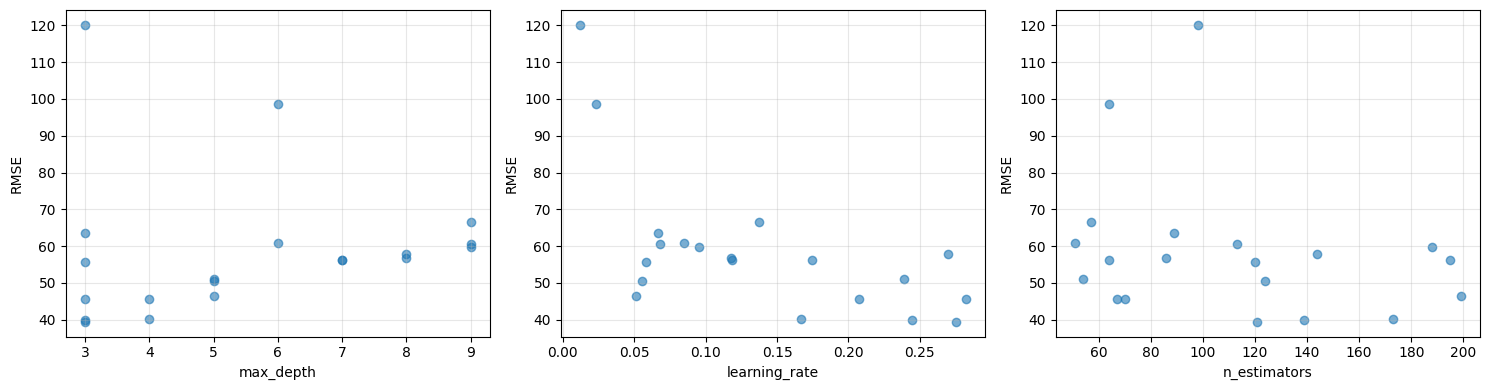
Visualize Search Results#
[6]:
# Extract results
results = random_search.cv_results_

# Plot hyperparameter vs score
fig, axes = plt.subplots(1, 3, figsize=(15, 4))

for ax, param in zip(axes, ['param_max_depth', 'param_learning_rate', 'param_n_estimators']):
    x = [p for p in results[param]]
    y = -results['mean_test_score']
    ax.scatter(x, y, alpha=0.6)
    ax.set_xlabel(param.replace('param_', ''))
    ax.set_ylabel('RMSE')
    ax.grid(True, alpha=0.3)

plt.tight_layout()
plt.show()
Evaluate Best Model#
[7]:
# Get best model
best_model = random_search.best_estimator_

# Evaluate on test set
from sklearn.metrics import mean_squared_error, r2_score

y_pred = best_model.predict(X_test)
test_rmse = np.sqrt(mean_squared_error(y_test, y_pred))
test_r2 = r2_score(y_test, y_pred)

print(f"Test set performance:")
print(f"  RMSE: {test_rmse:.4f}")
print(f"  R²:   {test_r2:.4f}")
Test set performance:
  RMSE: 36.7469
  R²:   0.9563
Tuning Best Practices#
Start simple: Try defaults first
Learning rate first: Lower is usually better (with more trees)
Tree depth: Start with 4-6, increase if underfitting
Regularization: Add if overfitting (subsample, colsample, reg_lambda)
Final tuning: Fine-tune n_estimators with early stopping
[8]:
# Recommended tuning workflow
print("Recommended tuning order:")
print("1. Set learning_rate=0.1, n_estimators=1000 (with early stopping)")
print("2. Tune max_depth and min_child_weight")
print("3. Tune subsample and colsample_bytree")
print("4. Tune reg_lambda and reg_alpha")
print("5. Lower learning_rate, increase n_estimators")
Recommended tuning order:
1. Set learning_rate=0.1, n_estimators=1000 (with early stopping)
2. Tune max_depth and min_child_weight
3. Tune subsample and colsample_bytree
4. Tune reg_lambda and reg_alpha
5. Lower learning_rate, increase n_estimators
Summary#
In this tutorial, you learned:
✅ Key hyperparameters and their effects
✅ Grid search for small parameter spaces
✅ Random search for larger parameter spaces
✅ Best practices for efficient tuning
Next Steps#
Tutorial 08: Explainability — Interpret model predictions
Tutorial 09: Model Serialization — Save and load models